This Wikipedia page provides a detailed examination of the Jewish cemeteries in Essaouira, Morocco, documenting two significant burial grounds that serve as important historical and cultural landmarks for the city's once-thriving Jewish community. The page focuses on both the old cemetery (also known as the marine cemetery) and the new cemetery, offering insights into the Jewish heritage of this coastal Moroccan city. Located at coordinates 31°31′03″N 9°45′50″W, these cemeteries represent tangible connections to Essaouira's diverse religious and cultural past.
The old cemetery, dating back to 1775, stands as the more historically significant of the two sites, dramatically positioned by the sea with only a single wall separating it from the ocean. This marine cemetery contains approximately 2,400 tombstones crafted from rocky stones and served as the primary burial ground for Essaouira's large Jewish community until around 1875. The cemetery's most notable feature is the mausoleum of Rabbi Ḥaim Pinto, which draws numerous visitors and underscores the site's continued religious significance. The cemetery also pays tribute to various rabbis who served the community, highlighting the important role of religious leadership in the historical Jewish population of Essaouira.
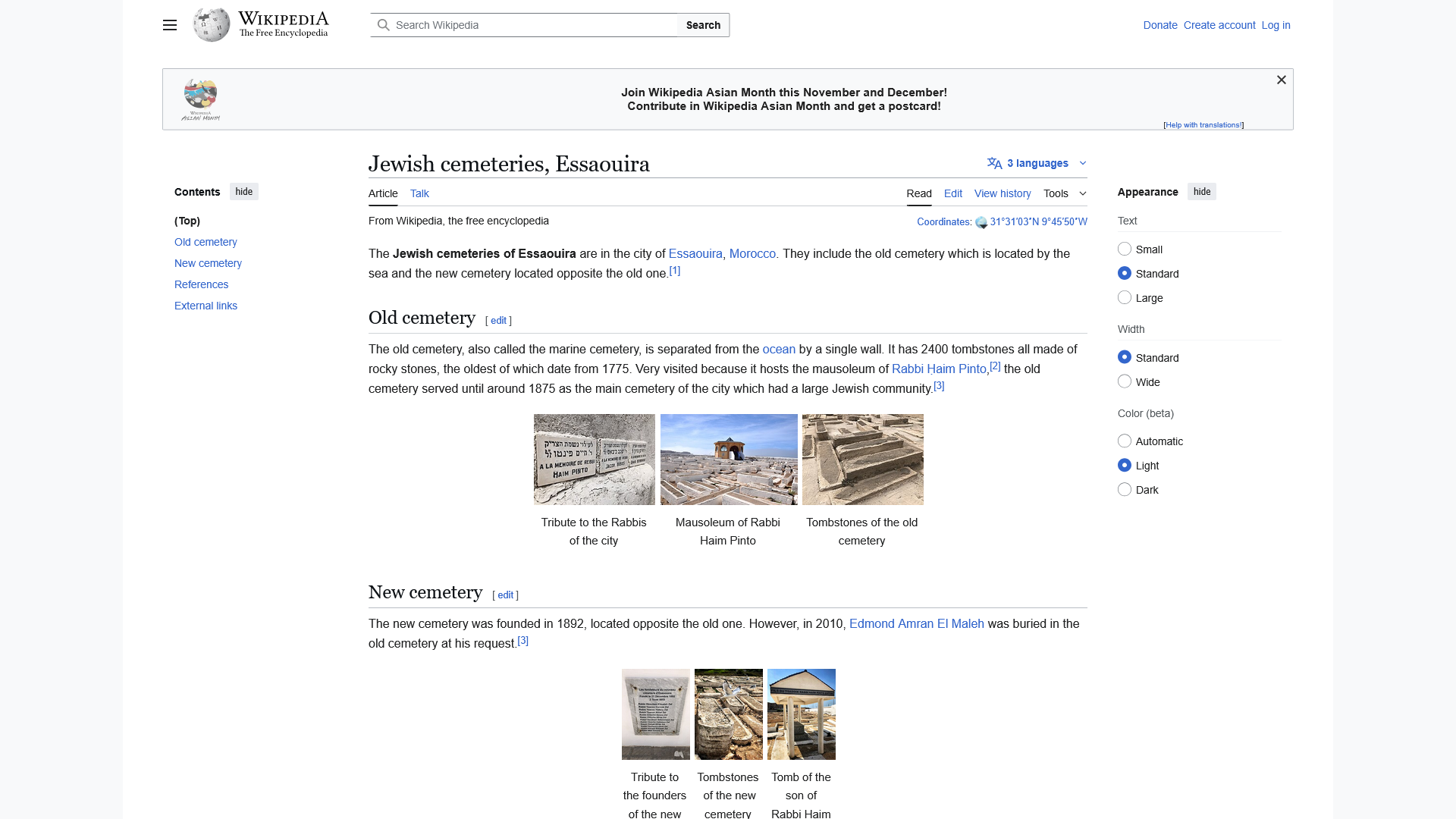
The newer cemetery, established in 1892 and located opposite the old one, represents the continued presence of the Jewish community into the modern era, though it reflects the community's gradual decline over time. Interestingly, the page notes that as recently as 2010, writer Edmond Amran El Maleh specifically requested to be buried in the old cemetery rather than the new one, demonstrating the enduring spiritual and cultural significance of the original burial ground. The article includes several photographic elements showing tributes to rabbis, tombstones from both cemeteries, and the mausoleum of Rabbi Haim Pinto, providing visual documentation of these important heritage sites.
The page is part of a broader Wikipedia framework documenting Jewish heritage in Morocco, as evidenced by the comprehensive navigation template that includes information about Moroccan Jewish history, culture, languages, communities, and institutions. The article cites academic sources and cultural organizations, including references to scholarly works on Jewish and Muslim migrants in the Maghreb and documentation from the World Monuments Fund, indicating its value for researchers studying Jewish diaspora history, Moroccan cultural heritage, and religious architecture in North Africa.
Cette page Wikipédia présente une documentation détaillée des cimetières juifs d'Essaouira, ville côtière du Maroc, révélant un patrimoine historique et religieux remarquable. L'article se concentre sur deux sites distincts : l'ancien cimetière, également appelé cimetière marin, et le nouveau cimetière fondé en 1892. Ces lieux témoignent de la présence significative d'une communauté juive florissante à Essaouira, particulièrement aux XVIIIe et XIXe siècles, et constituent aujourd'hui des sites de mémoire et de pèlerinage importants.
L'ancien cimetière, situé en bord de mer et séparé de l'océan par un simple mur, constitue le cœur historique de ce patrimoine funéraire avec ses 2400 pierres tombales taillées dans la roche locale, dont les plus anciennes remontent à 1775. Le site accueille le mausolée du rabbin Ḥaim Pinto, figure religieuse vénérée qui attire de nombreux visiteurs et pèlerins. Ce cimetière a servi de nécropole principale jusqu'en 1875 environ, période où la communauté juive d'Essaouira était particulièrement importante. Le nouveau cimetière, établi en face de l'ancien en 1892, témoigne de l'évolution et de la continuité de cette communauté, bien qu'il soit notable qu'en 2010, l'écrivain Edmond Amran El Maleh ait expressément demandé à être inhumé dans l'ancien cimetière.
L'article s'appuie sur des sources académiques variées, notamment des travaux de recherche sur les migrations juives et musulmanes au Maghreb, ainsi que des ressources du World Monuments Fund, soulignant l'importance patrimoniale internationale de ces sites. La page s'inscrit dans un contexte encyclopédique plus large consacré aux juifs et au judaïsme au Maroc, incluant des liens vers d'autres cimetières juifs du pays (Marrakech, Meknès) et des éléments culturels comme les langues judéo-berbère et judéo-arabe marocaine. Cette documentation précise, enrichie de coordonnées géographiques et de références photographiques, constitue une ressource précieuse pour les historiens, les chercheurs en études juives et les personnes intéressées par le patrimoine multiculturel du Maroc.
דף הוויקיפדיה הזה עוסק בבתי הקברות היהודיים בעיר אסווירה שבמרוקו, ומציג תיעוד מפורט של שני בתי קברות חשובים המשקפים את ההיסטוריה העשירה של הקהילה היהודית במקום. העמוד מתמקד בתיאור המורשת הקבורה של יהודי המدינה, החל מהמאה ה-18 ועד לימינו, ומהווה מקור מידע חשוב עבור חוקרי ההיסטוריה היהודית-מרוקאית, גנאלוגים ומתעניינים במורשת הקהילות היהודיות בצפון אפריקה.
בית הקברות הישן, הידוע גם בשם "בית הקברות הימי", מתוארך לשנת 1775 ומכיל 2,400 מצבות עשויות מאבן מקומית. הוא ממוקם בסמוך לים ומופרד ממנו רק בקיר יחיד, דבר המעניק לו אופי ייחודי. בית הקברות זוכה לביקורים רבים בעיקר בזכות האוזיאון של הרב חיים פינטו, שמהווה מוקד עלייה לרגל. המקום שימש כבית הקברות הראשי של העיר עד כ-1875, תקופה בה התגוררה באסווירה קהילה יהודית גדולה ומשגשגת שתרמה רבות לפיתוח הכלכלי והתרבותי של העיר.
בית הקברות החדש נוסד ב-1892 מול הישן, והמשיך לשרת את הקהילה עד להקטנתה המשמעותית. באופן מעניין, אפילו בשנת 2010 נקבר שם הסופר היהודי-מרוקאי אדמונד עמרן אל-מאלח בבית הקברות הישן לפי בקשתו המפורשת, דבר המדגיש את החיבור הרגשי והרוחני הנמשך למקום. הדף כולל תמונות של מצבות, האוזיאון וקברי דמויות חשובות, ומספק קישורים למקורות אקדמיים ואתרי מורשת שמאפשרים העמקה נוספת בנושא. המידע מובא על רקע הקשר היסטורי רחב יותר של יהודי מרוקו, עם התייחסות לתרבות, לשון ומסורות מיוחדות שהתפתחו במרחב הצפון-אפריקאי.
تتناول هذه الصفحة من ويكيبيديا موضوع المقابر اليهودية في مدينة الصويرة بالمغرب، والتي تُعد جزءاً مهماً من التراث اليهودي المغربي. تركز الصفحة على وصف مقبرتين رئيسيتين: المقبرة القديمة المعروفة بالمقبرة البحرية والتي تقع بجانب المحيط، والمقبرة الجديدة المقابلة لها. تُعتبر هذه المقابر شاهداً على وجود جالية يهودية كبيرة ومزدهرة في الصويرة عبر التاريخ، وتحتفظ بأهمية دينية وثقافية كبيرة للمجتمع اليهودي المغربي.
تُقدم الصفحة تفاصيل دقيقة حول المقبرة القديمة، التي تضم 2400 شاهد قبر مصنوعة من الحجارة الصخرية، يعود أقدمها إلى عام 1775. تحظى هذه المقبرة بزيارات كثيفة لاحتوائها على ضريح الحاخام حاييم بينتو، وقد خدمت كمقبرة رئيسية للمدينة حتى حوالي عام 1875. أما المقبرة الجديدة فقد تأسست عام 1892، وتقع مقابل القديمة. من اللافت أن الكاتب إدمون عمران المالح دُفن في المقبرة القديمة عام 2010 بناءً على طلبه، مما يُظهر الأهمية الرمزية المستمرة لهذا الموقع.
تكتسب هذه الصفحة أهميتها الأكاديمية والثقافية من خلال توثيقها لجانب مهم من جوانب التراث اليهودي في المغرب، خاصة في مدينة الصويرة التي كانت تُعرف تاريخياً بـ"موجادور". تستهدف الصفحة الباحثين المهتمين بالتاريخ اليهودي المغربي، والسياح الثقافيين، وعلماء الأنثروبولوجيا الدينية. تتميز الصفحة بتضمينها صوراً فوتوغرافية للمواقع وشواهد القبور، بالإضافة إلى معلومات جغرافية دقيقة (الإحداثيات)، ومراجع أكاديمية موثقة باللغتين الإنجليزية والفرنسية. كما تربط الصفحة هذا الموضوع بسياق أوسع للثقافة اليهودية المغربية من خلال قسم "اليهود واليهودية في المغرب" الذي يغطي التاريخ والثقافة والمجتمعات والتراث اليهودي في المملكة.
Esta página de Wikipedia se centra en los cementerios judíos de Essaouira, una ciudad costera de Marruecos, documentando un patrimonio histórico de gran importancia para la comunidad judía marroquí. El artículo describe detalladamente dos cementerios distintos: el cementerio antiguo (también conocido como cementerio marino) y el cementerio nuevo, ambos testigos de la rica historia judía de esta ciudad atlántica. La página forma parte del extenso proyecto de Wikipedia sobre el judaísmo y los judíos en Marruecos, proporcionando información específica sobre estos sitios de memoria que reflejan siglos de presencia judía en el norte de África.
El cementerio antiguo constituye el núcleo histórico más significativo, separado del océano Atlántico únicamente por un muro y albergando 2.400 lápidas de piedra, las más antiguas de las cuales datan de 1775. Este cementerio alcanzó particular relevancia como lugar de peregrinación debido al mausoleo del Rabino Ḥaim Pinto, una figura venerada que atrae numerosos visitantes. Funcionó como el principal cementerio de la ciudad hasta aproximadamente 1875, período durante el cual Essaouira (entonces conocida como Mogador) mantenía una próspera y numerosa comunidad judía que desempeñaba un papel económico y cultural fundamental en la región.
El cementerio nuevo, establecido en 1892 frente al antiguo, representa la continuidad de la tradición funeraria judía en Essaouira durante el período colonial y postcolonial. Un dato particularmente interesante es que en 2010, el escritor Edmond Amran El Maleh fue enterrado en el cementerio antiguo a petición propia, subrayando la conexión emocional y cultural que estos lugares mantienen incluso para las generaciones contemporáneas. El artículo incluye coordenadas geográficas precisas y fotografías que muestran tanto las lápidas históricas como los mausoleos, además de referencias académicas que sitúan estos cementerios dentro del contexto más amplio de los estudios sobre las migraciones judías y musulmanas en el Magreb entre los siglos XV y XX.
La página presenta elementos multimedia significativos, incluyendo fotografías de las lápidas, los mausoleos y tributos a los rabinos locales, así como enlaces a recursos externos como Find a Grave y el World Monuments Fund. Además, se integra en una extensa plantilla de navegación sobre judíos y judaísmo en Marruecos, que abarca desde la historia y cultura hasta las comunidades contemporáneas, sinagogas, museos y tradiciones como la Mimouna, proporcionando así un contexto cultural más amplio para entender la importancia de estos cementerios dentro del patrimonio judío marroquí.