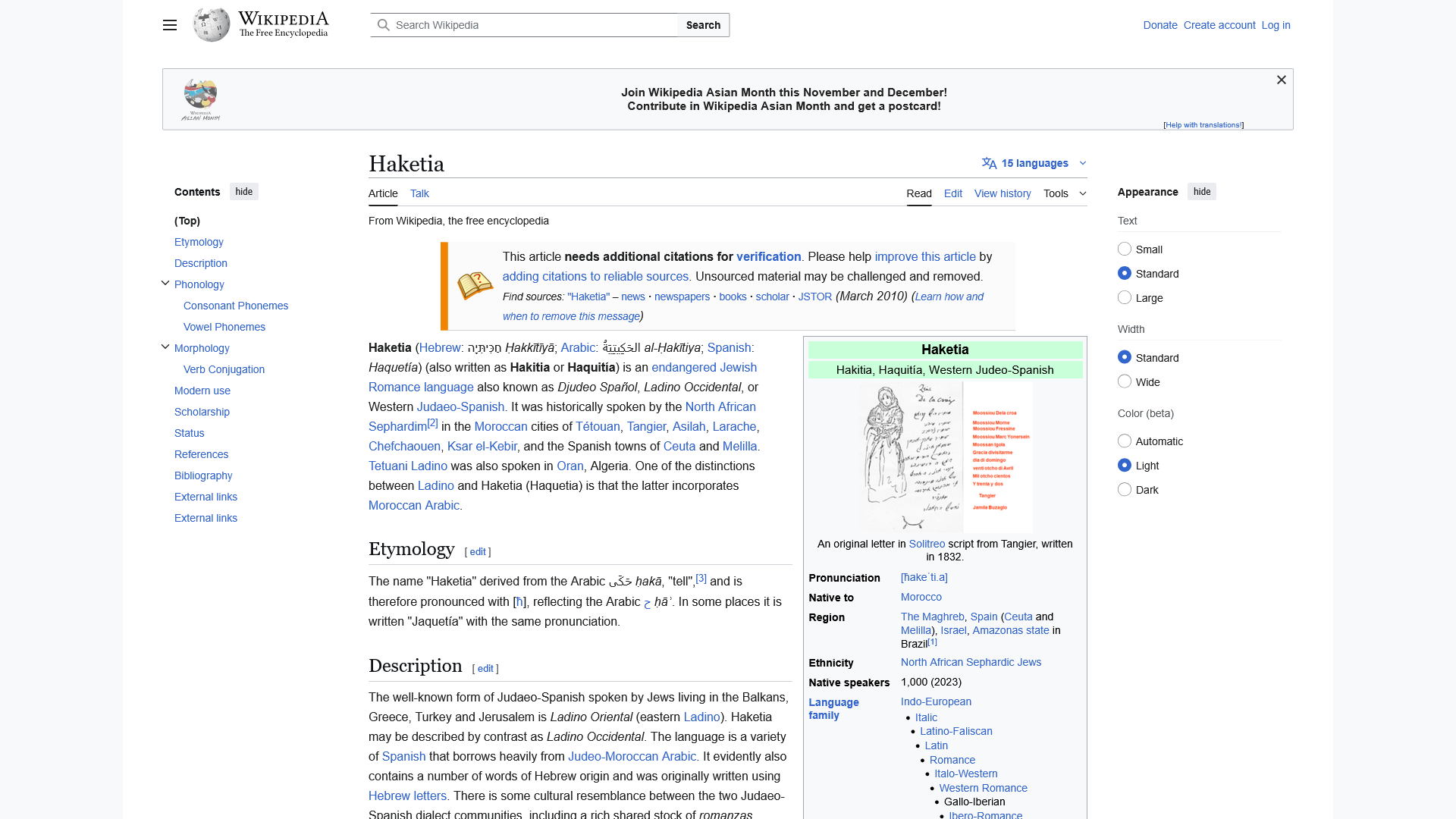
This Wikipedia article provides a comprehensive overview of Haketia, a distinctive form of Judaeo-Spanish historically spoken by Sephardic Jewish communities in North Africa. The page serves as the primary English-language reference for this endangered language, documenting its linguistic features, geographical distribution, and cultural significance within the broader context of Jewish diaspora languages. Haketia represents a fascinating example of how Jewish communities preserved and adapted their Iberian linguistic heritage after the expulsion from Spain in 1492, developing a unique variant that incorporated local North African influences.
The article reveals that Haketia is critically endangered, with only approximately 1,000 native speakers remaining as of 2023, primarily located in Morocco, with smaller communities in Spain's North African territories (Ceuta and Melilla), Israel, and Brazil's Amazonas state. Linguistically, the language belongs to the West Iberian branch of Romance languages and developed from Castilian Spanish through Old Spanish and Proto-Romance roots. The page details important dialectological information, noting the Tetuani dialect and explaining that Haketia was traditionally written using Hebrew scripts (Rashi or Solitreo), though Latin script is now more commonly used. A particularly valuable element is the inclusion of an original 1832 letter written in Solitreo script from Tangier, providing tangible evidence of the language's historical usage.
The article situates Haketia within the broader historical and cultural context of Sephardic Judaism, incorporating it into an extensive navigation framework that covers Jewish communities worldwide, religious practices, and historical developments. This contextual embedding demonstrates how Haketia represents not merely a linguistic phenomenon but a crucial component of North African Sephardic Jewish identity and heritage. The page includes a detailed map showing historical and modern Judeo-Spanish speech communities throughout the Mediterranean, clearly positioning Haketia's geographic significance in the southwest Mediterranean region.
Notable features of the article include its comprehensive linguistic classification system, detailed geographical distribution data, and integration within Wikipedia's extensive Jewish studies framework. However, the page also displays a citation notice from 2010, indicating that additional scholarly sources are needed to fully verify some claims. The article serves both academic researchers studying endangered Jewish languages and community members seeking to understand their linguistic heritage, though its current state suggests ongoing work is needed to enhance its scholarly rigor and completeness.
Cette page Wikipédia présente une analyse approfondie de l'hakétia, une variante historique du judéo-espagnol parlée par les communautés séfarades d'Afrique du Nord. L'article explore cette langue fascinante qui constitue une branche distincte du ladino traditionnel, adaptée aux spécificités culturelles et linguistiques du Maghreb. L'hakétia, également orthographiée Hakitia ou Haquitía, représente un patrimoine linguistique unique né de la rencontre entre l'héritage espagnol des Juifs expulsés en 1492 et les influences berbères et arabes de leur terre d'accueil nord-africaine.
L'article révèle que cette langue appartient à la famille indo-européenne et descend directement du castillan à travers une évolution complexe : latin vulgaire → proto-roman → vieux castillan → judéo-espagnol → hakétia. Géographiquement, elle était principalement parlée au Maroc, avec des extensions dans d'autres régions du Maghreb, les enclaves espagnoles de Ceuta et Melilla, ainsi que des communautés diasporiques en Israël et même dans l'État brésilien d'Amazonas. La page indique qu'en 2023, seulement 1 000 locuteurs natifs subsistent, témoignant de l'urgence de préserver ce patrimoine linguistique menacé. L'hakétia possède notamment un dialecte tétuani et utilisait traditionnellement l'alphabet hébraïque avec les scripts Rashi ou Solitreo, comme l'illustre une lettre originale de Tanger datée de 1832.
Un élément particulièrement remarquable de cette page est sa contextualisation dans l'ensemble des communautés judéo-espagnoles méditerranéennes, avec une carte historique distinguant les anciens foyers de peuplement des communautés modernes encore actives. L'article s'inscrit dans une série encyclopédique exhaustive sur le judaïsme et les communautés juives, offrant des liens vers des aspects religieux, historiques, textuels et démographiques. Cette approche systématique permet aux lecteurs de situer l'hakétia dans le continuum plus large de l'expérience séfarade, depuis l'Espagne médiévale jusqu'aux dispersions contemporaines. La page constitue ainsi une ressource académique précieuse pour les linguistes, historiens et anthropologues s'intéressant aux langues juives, aux migrations séfarades et à la diversité culturelle du monde judéo-méditerranéen.
הדף בוויקיפדיה עוסק בחקיטיה (Haketia), שהיא צורה מקומית של ספרדית יהודית (לאדינו) שדוברה היסטורית על ידי יהודים ספרדים בצפון אפריקה, בעיקר במרוקו ובאזור המגרב. הדף מציג מידע מקיף על השפה הייחודית הזו, הכוללת מאפיינים בולטים מהספרדית הישנה עם השפעות ערביות ועבריות. השפה התפתחה בקרב קהילות יהודי צפון אפריקה לאחר גירוש ספרד ב-1492, כאשר פליטים יהודים הביאו עמם את הספרדית הימי-ביניימית והתאימו אותה לסביבתם החדשה במגרב.
על פי המידע המוצג, כיום נותרו רק כ-1,000 דוברי חקיטיה ילידים (נכון ל-2023), מה שמעמיד את השפה בסכנת הכחדה. השפה נכתבה במקור באותיות עבריות, בעיקר בכתב רש"י או בכתב סוליטראו (כפי שמוצג במכתב מקורי מטנג'יר מ-1832 המופיע בדף), אך כיום נכתבת בעיקר באלפבית לטיני. חקיטיה מדוברת כיום בעיקר באיזורי מגורים בישראל, במקומות בספרד (סאוטה ומלייה), ובקהילות קטנות במדינת אמזונס שבברזיל. הדף מציין קיומם של דיאלקטים שונים, כמו הדיאלקט התטואני.
הדף מספק הקשר היסטורי וגיאוגרפי חשוב, כולל מפה המציגת קהילות דוברי ספרדית יהודית היסטוריות ומודרניות באגן הים התיכון, כאשר חקיטיה ממוקמת בדרום-מערב הים התיכון. כמו כן, הדף כולל קישורים נרחבים למקורות נוספים על יהדות, היסטוריה יהודית, וקהילות יהודיות ברחבי העולם, מה שמעמיד את חקיטיה בהקשר הרחב יותר של התפוצה הספרדית-יהודית. חשוב לציין שהדף מסומן כזקוק לציטוטים נוספים ולשיפור המקורות, מה שמעיד על הצורך במחקר נוסף ובתיעוד מדויק יותר של השפה הנדירה הזו.
تتناول هذه الصفحة من موسوعة ويكيبيديا موضوع **الحاكيتيا** (Haketia)، وهي إحدى أشكال اللغة الإسبانية اليهودية التاريخية التي تحدث بها اليهود السفارديم في شمال أفريقيا. تُعرف هذه اللغة أيضاً بأسماء أخرى مثل هاكيتيا أو هاكيتيا الغربية، وهي فرع من عائلة اللغات الهندوأوروبية تنتمي تحديداً إلى مجموعة اللغات الرومانسية الإيبيرية. تُظهر الصفحة خريطة تاريخية لمجتمعات المتحدثين بالإسبانية اليهودية في منطقة البحر الأبيض المتوسط، مع تمييز المجتمعات الحديثة بدوائر مطوقة، حيث تُتحدث الحاكيتيا في جنوب غرب البحر الأبيض المتوسط.
من الناحية اللغوية والديموغرافية، تشير المعلومات إلى أن الحاكيتيا كانت تُتحدث أساساً في المغرب ومنطقة المغرب العربي، بالإضافة إلى مناطق في إسبانيا (سبتة ومليلية)، وإسرائيل، وولاية الأمازون في البرازيل. يبلغ عدد الناطقين الأصليين بهذه اللغة حوالي 1000 شخص وفقاً لإحصائيات عام 2023، مما يجعلها من اللغات المهددة بالانقراض. تنقسم اللغة إلى لهجات مختلفة مثل التطواني لادينو، وكانت تُكتب تاريخياً بالأبجدية العبرية باستخدام خطوط راشي أو سوليتريو، بينما تُكتب اليوم غالباً بالأحرف اللاتينية.
تحمل هذه الصفحة أهمية أكاديمية وثقافية كبيرة كونها تؤرخ لتراث لغوي فريد يعكس تاريخ الهجرة والثقافة اليهودية في شمال أفريقيا. تتضمن الصفحة صورة لرسالة أصلية مكتوبة بخط سوليتريو من طنجة يعود تاريخها إلى عام 1832، مما يوفر دليلاً تاريخياً ملموساً على استخدام هذه اللغة. كما تحتوي الصفحة على قسم شامل عن اليهودية والمجتمعات اليهودية حول العالم، مما يضع الحاكيتيا في سياقها الثقافي الأوسع. تستهدف المقالة الباحثين في اللسانيات والدراسات اليهودية والمهتمين بتاريخ اللغات المهددة بالانقراض، وتشير إلى الحاجة لمزيد من المصادر الموثوقة لتحسين المحتوى العلمي للمقالة.
Esta página de Wikipedia presenta un análisis exhaustivo del haketía, una forma histórica del judeoespañol hablada por las comunidades sefardíes del norte de África. El artículo se centra principalmente en documentar las características lingüísticas, la distribución geográfica y el estado actual de esta variante occidental del judeoespañol, también conocida como hakitia o haquitía. La página incluye información detallada sobre su pronunciación ([ħakeˈti.a]), su clasificación dentro de la familia lingüística indoeuropea como parte del romance ibérico, y su estrecha relación con el castellano y otras lenguas judeoespañolas.
El contenido revela aspectos fascinantes sobre la vitalidad y distribución del haketía en la actualidad. Según los datos presentados, la lengua cuenta con aproximadamente 1,000 hablantes nativos en 2023, distribuidos principalmente en Marruecos, la región del Magreb, las ciudades españolas de Ceuta y Melilla, Israel, y sorprendentemente en el estado de Amazonas en Brasil. El artículo destaca que históricamente se escribía utilizando el alfabeto hebreo, particularmente en las variantes Rashi o Solitreo (como se muestra en una carta original de Tánger de 1832), aunque actualmente se emplea principalmente el alfabeto latino. Entre sus dialectos se menciona específicamente el tetuaní ladino.
La página contextualiza el haketía dentro del panorama más amplio de las comunidades judías históricas en el Mediterráneo, incluyendo un mapa que muestra las comunidades de habla judeoespañola históricas y modernas, situando al haketía en el suroeste mediterráneo. El artículo forma parte de una serie más extensa sobre judíos y judaísmo, conectando aspectos lingüísticos con elementos culturales, religiosos e históricos. Cabe mencionar que el artículo incluye una advertencia editorial sobre la necesidad de citas adicionales para verificación, lo que sugiere que algunos aspectos requieren mayor documentación académica para cumplir completamente con los estándares de Wikipedia.