## Moroccan Jewish Diaspora: A Global Community Study
This webpage serves as an introduction to the comprehensive study of Moroccan Jewish diaspora communities worldwide, hosted on the Visiting Jewish Morocco website. The page establishes the striking demographic reality that while only about 2,500 Jews remained in Morocco as of 2020, approximately 1.2 million Moroccan Jews have dispersed across the globe, creating vibrant diaspora communities that far outnumber those who stayed in their ancestral homeland. The primary purpose is to provide a gateway for understanding how these scattered communities have evolved, adapted, and maintained their cultural identity across different continents and nations.
The content emphasizes that comprehending contemporary Jewish Morocco requires examining the experiences of Moroccan Jews in their primary destination countries: Israel, France, Canada, the United States, and various South American nations. The page poses critical questions about diaspora experiences, including integration challenges, cultural evolution, ongoing connections to Morocco, and relationships with Jews who remained in Morocco. This approach recognizes that the story of Moroccan Jewry cannot be told solely through the lens of those who stayed, but must encompass the global network of communities that emerged through migration patterns spanning several decades.
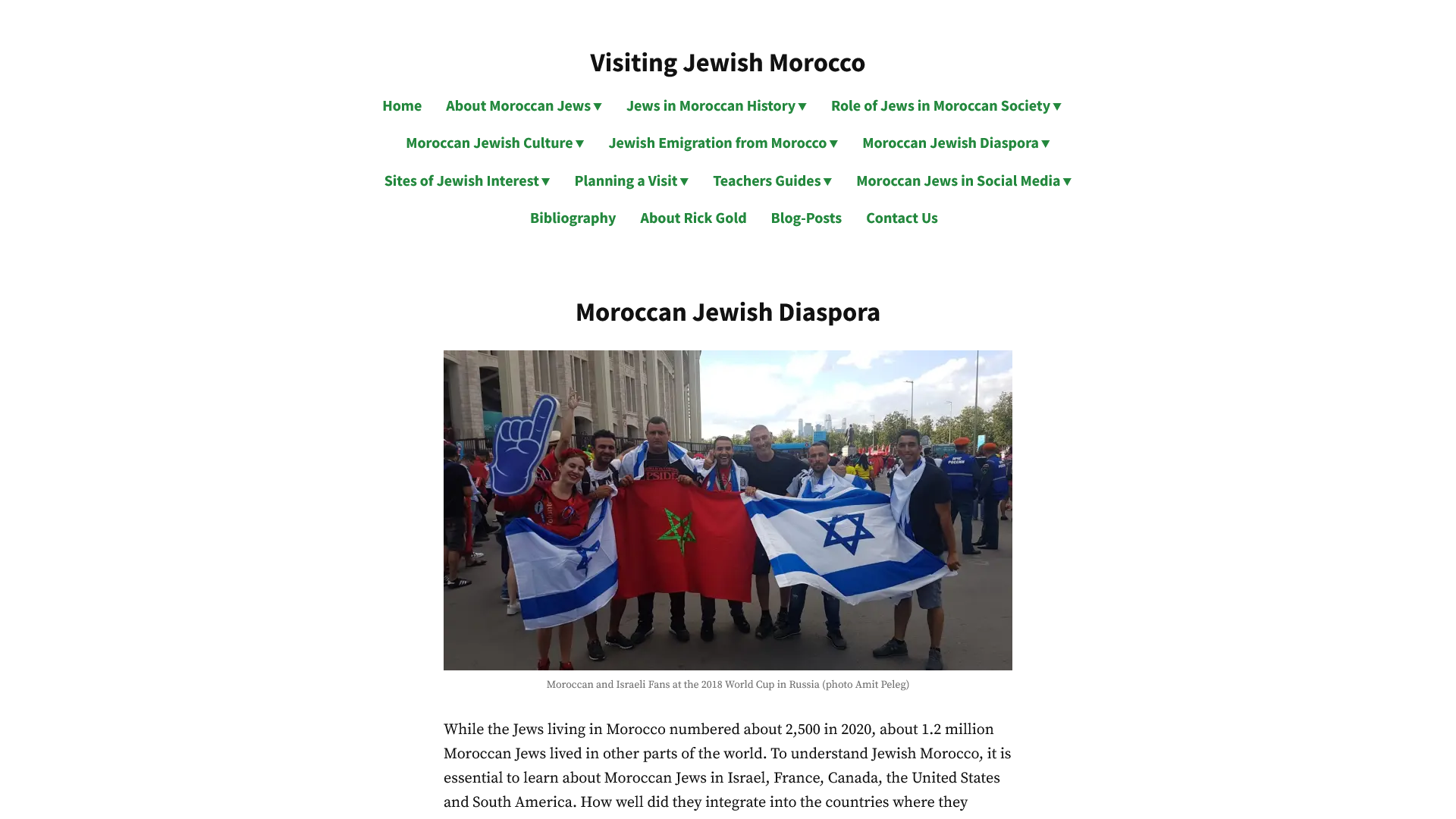
The webpage appears to target researchers, students, and individuals interested in Jewish history, migration studies, and North African cultural heritage. It serves as both an academic resource and a cultural bridge, acknowledging the complex emotions and relationships that diaspora communities maintain with their country of origin. The inclusion of a photograph showing Moroccan and Israeli fans together at the 2018 World Cup in Russia symbolically represents the ongoing cultural connections and dual loyalties that characterize many diaspora experiences.
The page functions as a hub for deeper exploration, with dedicated sections for each major diaspora region, suggesting a comprehensive, comparative approach to studying how Moroccan Jewish identity has been preserved, transformed, and transmitted across different national and cultural contexts. This structure indicates the website's commitment to providing detailed, region-specific analysis of one of the most significant Jewish diaspora movements of the 20th century.
Cette page web constitue une section dédiée à l'étude de la diaspora juive marocaine, un phénomène démographique et culturel d'une ampleur considérable. Le site "Visiting Jewish Morocco" présente ici une analyse comparative frappante : alors que seulement 2 500 Juifs vivaient encore au Maroc en 2020, près de 1,2 million de Juifs marocains étaient dispersés à travers le monde. Cette disproportion saisissante illustre l'ampleur de l'exode qui a marqué cette communauté au cours du XXe siècle, particulièrement après la création d'Israël en 1948 et l'indépendance du Maroc en 1956.
L'objectif principal de cette section est de proposer une approche holistique pour comprendre l'identité juive marocaine contemporaine. Les créateurs du site soutiennent qu'il est impossible de saisir pleinement la richesse et la complexité de la culture judéo-marocaine en se limitant uniquement aux communautés restées au Maroc. Ils posent des questions fondamentales sur l'intégration, l'évolution culturelle et le maintien des liens avec la terre d'origine : comment ces communautés se sont-elles adaptées dans leurs nouveaux pays ? Comment leur culture s'est-elle transformée ou préservée ? Quels sentiments conservent-elles envers le Maroc et comment les expriment-elles ?
La page structure son analyse autour des principales destinations de la diaspora : Israël, la France, le Canada, les États-Unis et l'Amérique latine, reflétant ainsi les différentes vagues migratoires et les choix géopolitiques qui ont influencé ces déplacements de population. Cette approche géographique permet d'examiner les spécificités de chaque contexte d'accueil et leurs impacts sur la préservation ou la transformation de l'identité culturelle. Le site s'adresse manifestement à un public académique et culturel intéressé par les études diasporiques et l'histoire des communautés juives du Maghreb.
Un élément particulièrement notable est la photographie d'ouverture montrant des supporters marocains et israéliens lors de la Coupe du monde 2018 en Russie, créditée à Amit Peleg. Cette image symbolique capture parfaitement la complexité des relations contemporaines entre le Maroc et ses anciens citoyens juifs, illustrant comment les liens culturels et émotionnels persistent malgré les frontières géographiques et politiques, et anticipant peut-être les accords de normalisation diplomatique entre le Maroc et Israël qui interviendront plus tard.
דף זה מתמקד בנושא הדיאספורה היהודית המרוקאית ומהווה חלק ממקור מקיף על יהדות מרוקו. המטרה המרכזית של הדף היא לבחון את חיי הקהילה היהודית המרוקאית מחוץ למרוקו, תוך הבנה שכדי להבין את יהדות מרוקו באופן מלא, יש להתמקד לא רק ביהודים החיים במרוקו כיום, אלא גם בקהילות הרחבות שנפזרו ברחבי העולם. הדף מציג נתון מרכזי המעיד על היקף התופעה: בעוד שכ-2,500 יהודים בלבד חיו במרוקו ב-2020, כ-1.2 מיליון יהודים ממוצא מרוקאי מתגוררים במדינות אחרות.
הדף מעלה שורה של שאלות מחקריות מרכזיות הנוגעות לחוויית הדיאספורה המרוקאית: כיצד השתלבו היהודים המרוקאים במדינות הקליטה השונות? איך התפתחה תרבותם לאורך השנים? מה רגשותיהם כלפי מרוקו ואיך הם מבטאים אותם? אלו קשרים הם מקיימים עם היהודים שעדיין חיים במרוקו? שאלות אלו מצביעות על גישה רב-ממדית החוקרת את ההיבטים החברתיים, התרבותיים והזהותיים של הגירה יהודית.
הדף מזהה חמישה מוקדי התיישבות עיקריים של יהודי מרוקו: ישראל, צרפת, קנדה, ארצות הברית ואמריקה הלטינית, כשלכל אזור מוקדש מקטע נפרד. מבחינה ויזואלית, הדף כולל תמונה סמלית של אוהדי מרוקו וישראל במונדיאל 2018 ברוסיה, המדגימה את הקשרים המורכבים והרגשיים בין הקהילות המרוקאיות-יהודיות לארץ מוצאן. זהו משאב אקדמי הפונה לחוקרים, סטודנטים ואנשי קהילה המעוניינים להבין את התרבות וההיסטוריה היהודית המרוקאית בפרספקטיבה עולמית, תוך הכרה בעובדה שחקר יהדות מרוקו אינו יכול להסתפק בגבולות הגאוגרפיים של מרוקו עצמה.
تتناول هذه الصفحة من موقع "زيارة المغرب اليهودي" موضوعاً بالغ الأهمية وهو الشتات اليهودي المغربي حول العالم. تهدف الصفحة إلى تسليط الضوء على الواقع المعاصر لليهود المغاربة الذين يعيشون خارج المغرب، حيث تشير إلى إحصائية مذهلة تكشف أنه بينما لا يتجاوز عدد اليهود المقيمين في المغرب حالياً 2,500 شخص (وفقاً لإحصائيات 2020)، فإن حوالي 1.2 مليون يهودي مغربي يعيشون في بلدان أخرى حول العالم. هذا التباين الكبير يعكس حجم الهجرة اليهودية من المغرب عبر العقود الماضية.
تطرح الصفحة أسئلة جوهرية حول تجربة الاندماج والهوية الثقافية لهؤلاء المهاجرين، مؤكدة على أن فهم اليهودية المغربية لا يمكن أن يكتمل دون دراسة أحوال اليهود المغاربة في بلدان المهجر الرئيسية وهي إسرائيل وفرنسا وكندا والولايات المتحدة وأمريكا الجنوبية. تتساءل حول مدى نجاح اندماجهم في المجتمعات الجديدة، وكيفية تطور ثقافتهم، وما هي مشاعرهم تجاه المغرب وطرق التعبير عنها، بالإضافة إلى طبيعة العلاقات التي يحتفظون بها مع اليهود الذين ما زالوا يعيشون في المغرب.
تكتسب هذه الصفحة أهمية خاصة من الناحية التاريخية والثقافية، حيث تعكس جانباً مهماً من التاريخ المغربي المعاصر وتتناول موضوع الهجرة اليهودية التي شكلت ظاهرة بارزة في القرن العشرين. الصورة المرافقة للنص والتي تُظهر مشجعين مغاربة وإسرائيليين معاً في كأس العالم 2018 في روسيا تحمل دلالة رمزية قوية على استمرار الروابط الثقافية والعاطفية بين المغرب ويهوده في المهجر. تبدو الصفحة موجهة للباحثين والمهتمين بالتاريخ اليهودي المغربي والدراسات الثقافية، وتشكل جزءاً من مشروع توثيقي أوسع يهدف إلى الحفاظ على الذاكرة اليهودية المغربية ودراسة تجلياتها المعاصرة.
تتميز الصفحة بتنظيمها الواضح الذي يقسم الشتات اليهودي المغربي حسب القارات والبلدان، مما يتيح للزوار استكشاف كل منطقة جغرافية على حدة. هذا التصنيف الجغرافي يعكس نهجاً منهجياً في دراسة الموضوع ويساعد في فهم الخصائص المميزة لكل جالية يهودية مغربية في بيئتها الجديدة، مما يجعل هذا المورد قيماً للدارسين والمهتمين بموضوعات الهجرة والهوية الثقافية والتراث اليهودي المغربي.
Esta página web se centra en el análisis exhaustivo de la diáspora judía marroquí, un fenómeno demográfico y cultural de gran envergadura que ilustra una de las migraciones judías más significativas del siglo XX. El propósito principal de la sección es explorar la experiencia de los aproximadamente 1.2 millones de judíos marroquíes que viven dispersos por el mundo, una cifra que contrasta dramáticamente con los apenas 2,500 judíos que permanecían en Marruecos en 2020. La página establece como premisa fundamental que para comprender verdaderamente el judaísmo marroquí contemporáneo, es imprescindible estudiar las comunidades que se establecieron en Israel, Francia, Canadá, Estados Unidos y América Latina.
El contenido aborda preguntas cruciales sobre la experiencia migratoria y la preservación cultural de estas comunidades. La página examina el grado de integración de los judíos marroquíes en sus países de destino, la evolución de sus tradiciones culturales en nuevos contextos, y los vínculos emocionales y prácticos que mantienen con Marruecos. Particularmente relevante es el análisis de cómo estas comunidades han expresado sus sentimientos hacia su país de origen y qué tipo de relaciones han mantenido con los judíos que permanecieron en Marruecos. Esta perspectiva bidireccional ofrece una visión integral de las dinámicas transnacionales que caracterizan a la diáspora judía marroquí.
La página forma parte del proyecto "Visiting Jewish Morocco", lo que sugiere un enfoque académico y cultural dirigido tanto a investigadores como a miembros de las propias comunidades judías marroquíes y personas interesadas en estudios de migración y patrimonio judío. El contexto histórico implícito remite a las grandes oleadas migratorias judías desde Marruecos, particularmente intensas tras la independencia del país en 1956 y los conflictos árabe-israelíes. Un elemento notable es la fotografía de aficionados marroquíes e israelíes en el Mundial de Fútbol de 2018 en Rusia, que simboliza las complejas pero persistentes conexiones entre Marruecos e Israel a través de su patrimonio judío compartido. La estructura de navegación organizada por países (Israel, Francia, Canadá, Estados Unidos, América Latina) indica un análisis comparativo detallado de cada experiencia diasporica específica.